Latest News on Our Blog
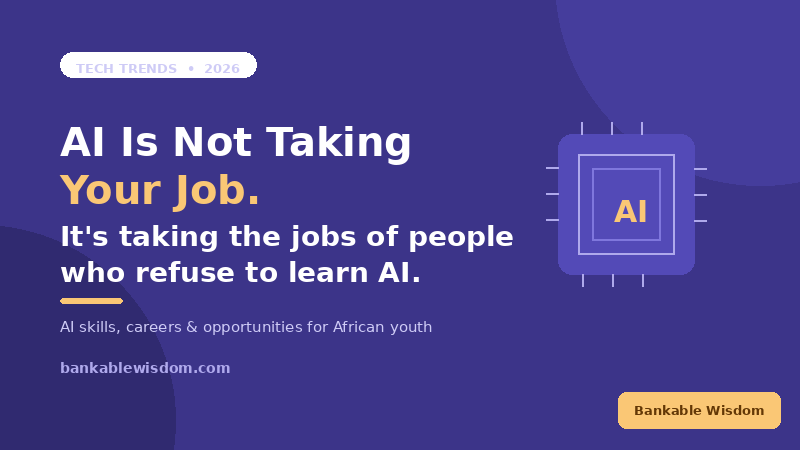
AI Skills Nigeria 2026: Why Learning AI Is the Most Important Career Move You Can Make Right Now
Every week, a Nigerian graduate asks the same question: "Will AI take my job?"
That is the wrong question entirely.
The right question is: "Am I building AI skills — or am I waiting to be replaced by someone who already did?"
In 2026, the data is no longer speculative. The shift is happening right now, across every sector in Nigeria and across the African continent.
How AI Is Already Reshaping Jobs in Nigeria and Africa
Artificial intelligence is now embedded in everyday African use cases, powering mobile lending platforms, fraud detection systems, customer support chatbots, language translation tools, and agricultural forecasting. Rather than eliminating development roles entirely, AI is reshaping them.
Developers and professionals are now expected to work faster, think more strategically, and take greater responsibility for performance, security, and long-term sustainability.
The bar is rising. So is the opportunity — for those who are prepared.
The Digital Skills Gap in Africa Is Your Competitive Advantage
Here is what most people miss about the AI revolution in Africa: the skills gap is massive, which means early movers gain disproportionate rewards.
AI and machine learning now top the list of in-demand skills globally due to an 866% demand surge, followed by cybersecurity to counter rising threats in fintech, and data analytics for Nigeria's growing tech sector.
More than 60% of future jobs will require digital skills — yet a structural gap remains, with youth unemployment across the continent continuing to rise.
That gap is not a death sentence. It is a market opening. Every young Nigerian who acquires AI skills today is entering a market where demand vastly outpaces supply.
Top AI and Tech Skills to Learn in Nigeria in 2026
The best tech skills to learn in 2026 will be shaped by rapid AI adoption, automation, and the growing need for secure, scalable digital systems. Professionals who master in-demand tech skills like cloud architecture, cybersecurity, AI engineering, and data science will see the strongest job opportunities, salaries, and career stability.
For Nigerian youth specifically, these five skill areas offer the clearest path to employment and income in 2026:
1. AI Prompt Engineering — using AI tools like ChatGPT and Claude to automate business tasks, create content, and solve problems. No coding required to start.
2. Data Analytics — reading, interpreting, and communicating data insights. Excel, Google Sheets, and Python are the common entry points.
3. Cybersecurity Fundamentals — protecting digital systems. Cybersecurity analysts earn between $125,000 and $150,000 globally, while penetration testers and security engineers can earn up to $180,000. Entry-level Nigerian roles are growing fast.
4. Digital Marketing with AI Tools — combining content creation, SEO, and AI-powered automation to run marketing campaigns.
5. No-Code/Low-Code Development — building apps, automations, and websites without traditional coding, using tools like Bubble, Webflow, and Zapier.
AI Education in Africa Is Already Expanding Fast
The University of Lagos is already the first African institution to launch an OpenAI Academy for capacity building — a clear signal that AI literacy is becoming a mainstream expectation inside Nigerian higher education, not a distant future trend.
African startups created 34,000 jobs in recent years, mostly in tech — but companies still face shortages in basic digital literacy. The companies are ready to hire. The talent pipeline is the missing link.
How Bankable Wisdom Is Closing the AI Skills Gap
At Bankable Wisdom, we train marginalised young Nigerians and Africans aged 18–35 in digital and AI skills — delivered via WhatsApp, the tool Africa already uses. No laptop required to start. No campus. No long commute.
Our learners are not in Silicon Valley. They are in Kano, Enugu, Blantyre, and Accra. And they are building skills that make them competitive not just locally, but globally.
The window to get ahead of this AI curve is still open. But it will not stay open indefinitely.
Start building your AI skills today at bankablewisdom.com