Over 20+ New Jobs Daily
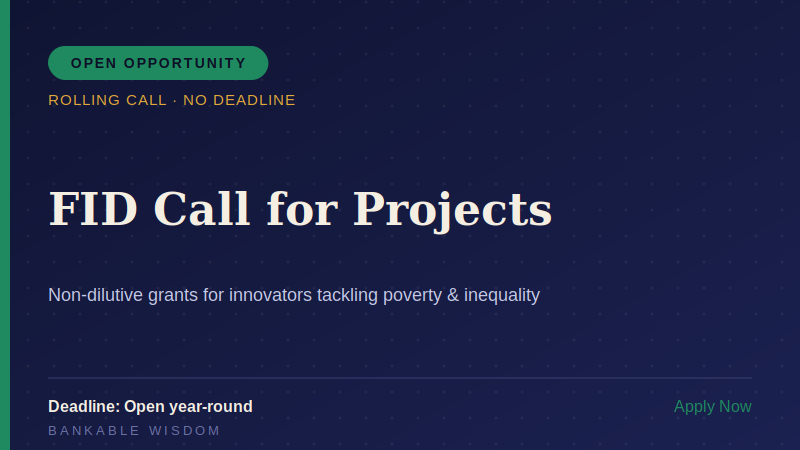
Opportunity Title: FID Call for Projects: Rolling Non-Dilutive Grant Funding for African Innovators
FID Call for Projects: Rolling Non-Dilutive Grant Funding for African Innovators
Unlike most grants and fellowships with a fixed closing date, the Fund for Innovation in Development (FID) Call for Projects is open year-round. There's no application window to miss — which makes it one of the most reliable, always-available funding options for organisations building innovative solutions in Nigeria and across Africa.
What Is the FID Call for Projects?
FID funds innovative solutions aimed at reducing inequalities and fighting poverty in low- and middle-income countries. There are no sector restrictions — FID welcomes applicants across health, education, agriculture, fintech, climate, and beyond, as long as the innovation is implemented in an eligible country.
Who Is Eligible for FID Funding?
- The project must be located in a country on the OECD DAC list of ODA recipients — Nigeria qualifies (only Burkina Faso, Mali, and Niger are excluded)
- Open to all types of organisations and collectives, applying independently or as part of a consortium
- Individual applications are not eligible — you must apply as a registered organisation, such as a company or NGO, not as an individual founder
How FID Funding Stages Work
FID tailors grant size and structure to how mature your project already is:
- Prototype/Pilot stage — funding to test or pilot an early-stage idea
- Rigorous evaluation stage — funding to formally evaluate a solution's impact
- First scale-up stage — funding to take a validated solution to its next level of reach
- Deployment through public entities — funding to support integration into public-sector delivery systems
FID provides a decision tree tool to help applicants self-identify which stage best fits their project before applying, reducing wasted effort on a mismatched application.
Application Documents You'll Need
- The official Call for Projects Guide (read this first — it explains the full procedure)
- The Decision Tree (to identify your correct funding stage)
- The Application Form (Word format)
- The Budget Template (Excel format, broken down by activity)
Why This Opportunity Is Worth Prioritising
Because FID's call is rolling, it's a grant you can build toward on your own timeline rather than rushing to meet a hard deadline. For organisations with real traction — paying customers, a validated pilot, or documented outcomes — this makes it a strong candidate for structured, unhurried grant applications rather than a last-minute scramble.
How to Apply
Deadline: None — open year-round Apply directly: https://fundinnovation.wiin.io/en/
Frequently Asked Questions
Does the FID Call for Projects have a deadline? No. The call for projects is open year-round, and applicants can submit at any time.
Can individuals apply for FID funding? No. FID funding is only open to organisations and collectives — either applying independently or as part of a consortium. Individual applications are not accepted.
Is Nigeria eligible for FID funding? Yes. Nigeria is on the OECD DAC list of ODA recipients and is eligible, along with all other listed low- and middle-income countries except Burkina Faso, Mali, and Niger.
What funding stages does FID support? FID supports four stages: prototyping/piloting an early idea, rigorously evaluating a solution's impact, a first scale-up, and deployment through public entities. A decision tree tool helps applicants identify the right stage.