Latest News on Our Blog
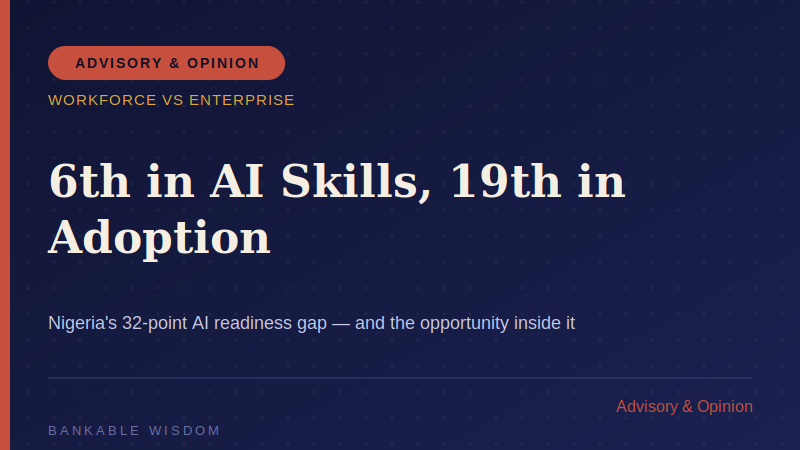
Nigeria's AI Skills Gap: Why 6th-Best Workforce Talent Isn't Translating Into Business Adoption
Nigeria's AI Skills Gap: Why 6th-Best Workforce Talent Isn't Translating Into Business Adoption
Nigeria has a paradox worth understanding if you run a business, train talent, or build workforce solutions in 2026: the country ranks 6th globally in AI workforce literacy — ahead of every other African outsourcing destination — yet scores just 34 out of 100 in enterprise AI adoption, placing it 19th globally. That 32-point gap between what workers can do and what businesses actually use is the largest disparity recorded in the 2026 Global Outsourcing AI Readiness Index.
This article explains what's driving Nigeria's AI skills gap, why it's a business opportunity in disguise, and what needs to happen to close it.
The Numbers Behind Nigeria's AI Paradox
- 6th globally — Nigeria's ranking for individual workforce AI literacy (ahead of Kenya, South Africa, Egypt, and other African markets)
- 34/100 — Nigeria's enterprise AI adoption score
- 19th globally — Nigeria's enterprise adoption ranking
- 19th globally — Nigeria's AI education pipeline readiness ranking, meaning formal education isn't producing AI-literate graduates at the pace self-taught workers are acquiring skills independently
Individual Nigerians are teaching themselves to use AI tools faster than almost anyone else on the planet. Institutions are not keeping pace.
Why Is There Such a Large Gap Between Nigerian Talent and Business Adoption?
The gap isn't a contradiction — it's a familiar pattern in Nigeria's digital economy. A bank employee in Lagos teaches herself AI tools on her own phone because nobody trained her and nobody is waiting for permission. A freelance designer in Enugu adopts generative AI to compete for international contracts because the upside is immediate.
Meanwhile, the enterprise down the street is still deciding whether AI adoption belongs in this year's budget. Individuals move at internet speed. Institutions move at institutional speed. That mismatch is the real driver of Nigeria's AI adoption gap.
Where the Opportunity Lies for Founders and SMEs
This gap is exactly where the market opportunity sits. Every enterprise that hasn't yet figured out how to deploy AI at the organisational level is a potential customer for structured, applied AI training — not another generic "what is AI" course, but hands-on, workflow-specific upskilling that converts individual competence into institutional capability.
That's a different product from what most training platforms currently sell, and it's precisely the underserved layer of Nigeria's digital skills market right now.
What Needs to Happen to Close the Gap
The Nigerian government has set a target of training 100,000 professionals in AI skills, but analysts note this scale doesn't match the urgency of a workforce numbering in the tens of millions. Closing the real gap requires:
- Institutional bridges that connect self-taught individual skill to organisational deployment
- Updated curricula in formal education to keep pace with self-directed learning
- SME-focused AI adoption programmes, not just individual literacy campaigns
The Bottom Line
Nigeria has already solved the harder problem — building a workforce that teaches itself. The remaining problem is institutional, not individual. Whoever builds the bridge between self-taught AI talent and business-level deployment — inside SMEs, schools, and mid-sized companies — will be solving the exact gap the data says Nigeria has right now.
Frequently Asked Questions
Why does Nigeria rank low in enterprise AI adoption despite high individual AI skills? Nigerian workers are self-teaching AI skills faster than businesses are building the infrastructure, budget, and strategy to deploy AI at an organisational level, creating a 32-point gap between talent and adoption.
What is Nigeria's AI skills gap ranking in 2026? Nigeria ranks 6th globally for workforce AI literacy but only 19th for enterprise AI adoption and 19th for AI education pipeline readiness, according to the 2026 Global Outsourcing AI Readiness Index.
How can Nigerian SMEs close the AI adoption gap? By investing in applied, workflow-specific AI training for existing staff rather than relying solely on individual self-learning, and by treating AI adoption as a budgeted strategic priority rather than an optional trend.