Latest News on Our Blog

Nigeria's Push for Sovereign AI: What GITEX 2026 Revealed
Something shifted at GITEX Nigeria 2026. The event, which ran from 31 August to 3 September across Abuja and Lagos, was not just a technology exhibition. It was a moment where Nigeria's government, its tech industry, and the global technology community sat in the same room and had a blunter conversation than usual about who controls Africa's digital future — and what Nigeria intends to do about it.
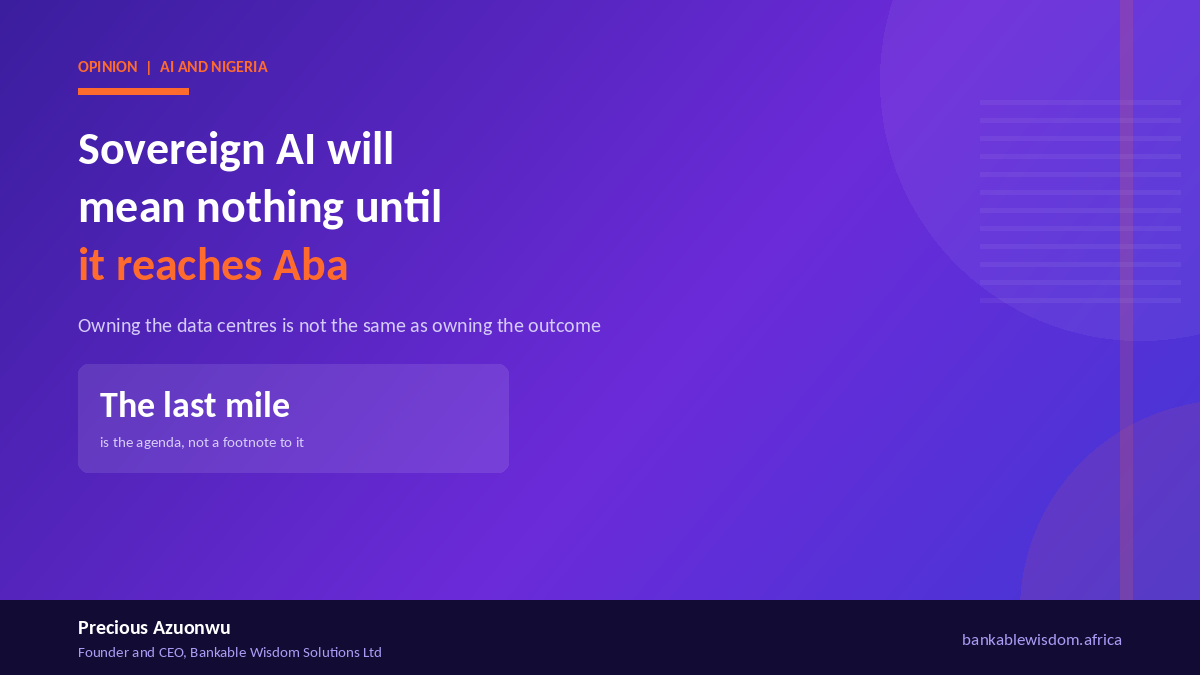
A central focus this year was sovereign AI and digital independence, with discussions on how African countries can reduce reliance on imported technologies and develop their own AI systems, infrastructure, and talent.
Kashifu Inuwa Abdullahi, Director General of NITDA, said artificial intelligence should no longer be viewed simply as another technological tool. For Nigeria, he argued, control over AI has become a matter of economic resilience, national security, and digital independence. He said AI sovereignty must cover the full technology chain, from internet connectivity and computing capacity to data centres, cloud infrastructure, data governance, and AI models.
What Was on the Table
The second edition of GITEX Nigeria was themed "Beyond Connectivity: The Bridge to Sovereign Innovation." The Government Leadership and AI Summit opened the event in Abuja with discussions on digital public infrastructure, AI adoption, cybersecurity, and the future of digital governance across Nigeria and West Africa. The event then moved to Lagos for the Tech Expo, Future Economy Conference, Startup Festival, and FDX Nigeria.
He cited the newly enacted NIMC Act 2026 as a major step toward strengthening Nigeria's digital identity and data management systems, and also disclosed plans for a 90,000-kilometre fibre-optic network to extend connectivity nationwide.
The GITEX Nigeria Startup Festival featured more than 750 startups from Nigeria and more than 25 countries, working across sectors including artificial intelligence, fintech, healthcare, education, agriculture, mobility, and climate technology. For investors, the startup programme offered an opportunity to discover emerging companies and meet founders, with networking access to investors managing more than $200 billion in global capital.
The $1 Trillion Number
Nigeria is positioning itself within Africa's projected $1 trillion AI economic uplift by 2035. That figure gives context to why the conversations at GITEX Nigeria were so pointed. A trillion-dollar opportunity does not arrive neutrally — it goes to the countries and companies that built the infrastructure, trained the talent, and governed the data that made it possible. Nigeria's argument at GITEX was that it intends to be one of those countries, not merely a consumer of the outcome.
What This Means for Nigerian Techies
Sovereign AI is not just a policy conversation. It is a jobs conversation. Building Nigeria's AI infrastructure — the data centres, cloud platforms, AI models, cybersecurity systems, and digital identity frameworks that "sovereignty" actually requires — means thousands of technical roles that do not yet exist at the scale Nigeria needs. The 3MTT's expansion into AI and data science training, NITDA's DeepTechReady programme, and the new EU partnership are all attempts to build the talent pipeline for those roles before the infrastructure need overtakes the available supply.
The debate in Abuja goes beyond AI itself. At stake is who owns the data, infrastructure, and systems that will define the next phase of Nigeria's digital economy.
For Nigerian techies who are building skills in AI, data, cloud, and cybersecurity right now, the GITEX conversations are a signal about where the demand is going. The professionals who are ready when Nigeria's sovereign AI infrastructure starts to scale are the ones who will shape it.
Follow ongoing coverage: https://gitexnigeria.ng
Bankable Wisdom Tip: "Sovereign AI" is now a term that will appear in Nigerian policy documents, procurement briefs, and job descriptions for years. If you work in tech or are building toward a tech career, learn what it actually means — not just the politics, but the technical stack. Data centres, cloud-native development, AI model training, data governance frameworks, and cybersecurity architecture are the practical disciplines underneath the phrase. Pick one of them and start building demonstrable skills in it today.