Latest News on Our Blog
The bottom rung is being sawn off, and Nigeria's graduates are next
The bottom rung is being sawn off, and Nigeria's graduates are next
There is a comfortable story about AI and jobs that says every technology destroys some work and creates more, so relax. There is a panicked story that says the graduate job is dead. The data landing this month supports neither, and what it does show should worry anyone in Nigeria running a skills programme or graduating a child this year.
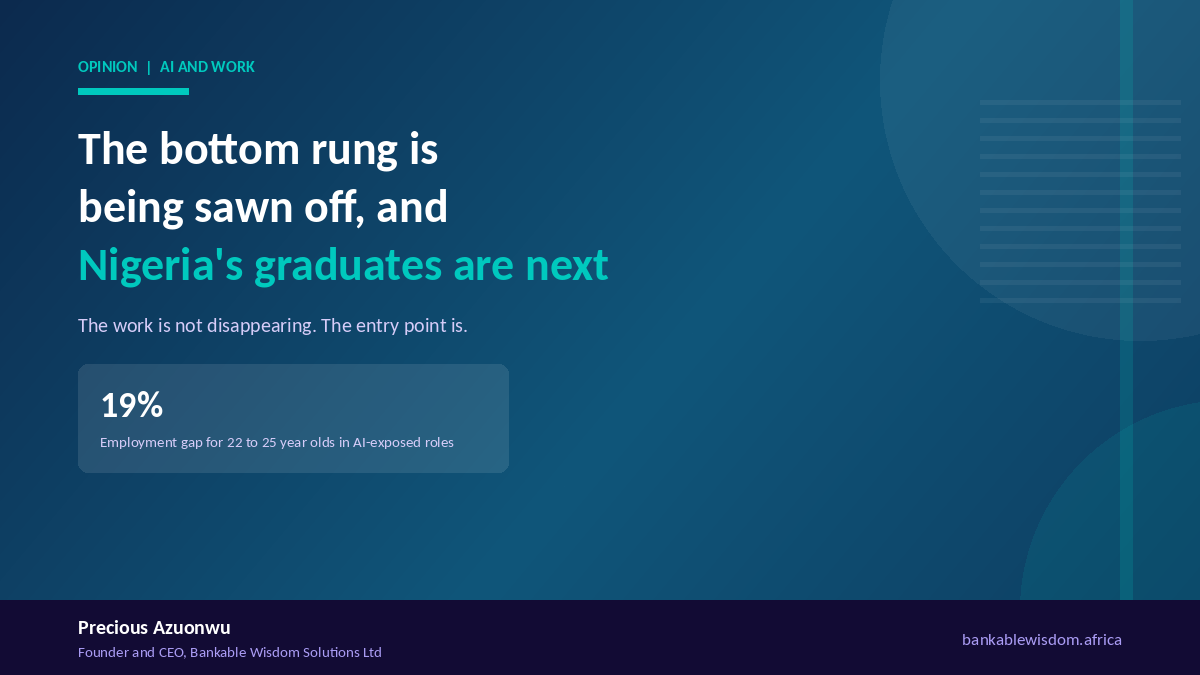
The Stanford Digital Economy Lab updated its research on ADP payroll data in August 2026, and employment of 22 to 25 year olds in AI-exposed occupations now trails the rest by 19 per cent, where a year earlier the gap was 13 per cent. Older workers in the same occupations are growing, so this is a tilt toward seniority rather than a shrinking market. Read that twice. The work is not disappearing. The entry point is.
Two more numbers from the same picture. Only 3 per cent of machine learning engineer postings and 2 per cent of AI product manager postings are entry level. And half of AI postings in the United States, 59 per cent in Germany, sit outside IT departments entirely. To be fair to the evidence, researchers are careful here: the most defensible summary as of September 2026 is that entry-level roles are narrowing and shifting in composition, and the authors of the headline study are explicit that this is descriptive rather than causal evidence. Nobody has proved AI is the sole cause. But nobody needs proof of causation to see the ladder.
Now put that beside our situation. Nigeria graduates hundreds of thousands of young people a year into a market where the traditional entry job was already scarce, where NYSC ends and the search begins, and where the standard advice has been to learn a tech skill. That advice was written for a market that hired juniors so they could become seniors. If firms increasingly hire experience and hand the junior tasks to a model, then "learn to code and wait to be hired" is a strategy aimed at a door that is closing.
I do not think the answer is to stop training. I think the answer is to change what training produces.
Stop selling certificates, start producing evidence. A certificate says you attended. Nobody is hiring attendance. Three deployed projects with a link, a before number and an after number will get a conversation that a PDF never will. Every training programme in this country, mine included, should be judged on whether its graduates leave with provable work, not with a badge.
Follow the demand where it actually sits. The growth is not in people who build models. It is in people who put AI into marketing, sales, support and paperwork, which is exactly what working with small and mid-size businesses looks like: find the process where AI pays off, build the agent or the integration, and get it to the people who use it. Nigeria has millions of small businesses and almost none of them have done this. A 24 year old who can walk into a logistics company in Ikeja and cut its quoting time in half is employable in a way that a 24 year old with a generic AI certificate is not.
Sell the outcome, not the hours. If the salaried junior role is thinner, the paid problem is not. Young Nigerians should be building the skill of walking into a business, finding one expensive process and fixing it for a fee. That is not a fallback. In a market where Gartner expects more than 40 per cent of agentic AI projects to be cancelled by the end of 2027, the people who survive are the ones tied to a measurable business result rather than to a hype cycle.
And employers, a word. If every firm refuses to hire juniors because the model is cheaper this quarter, we will collectively run out of seniors in about seven years. The junior you did not train is the mid-level engineer you will be unable to find in 2033. Somebody has to keep the bottom rung nailed on, and it will not be a foreign lab that does it for us.
The honest summary is this. AI has not taken the jobs. It has raised the floor of what counts as employable, and it has done so faster than our education system can react. That gap is where the next decade of Nigerian careers will be won or lost, and closing it is work for training providers, employers and government together, not a problem we can hand to a 23 year old and call it hustle.