Latest News on Our Blog
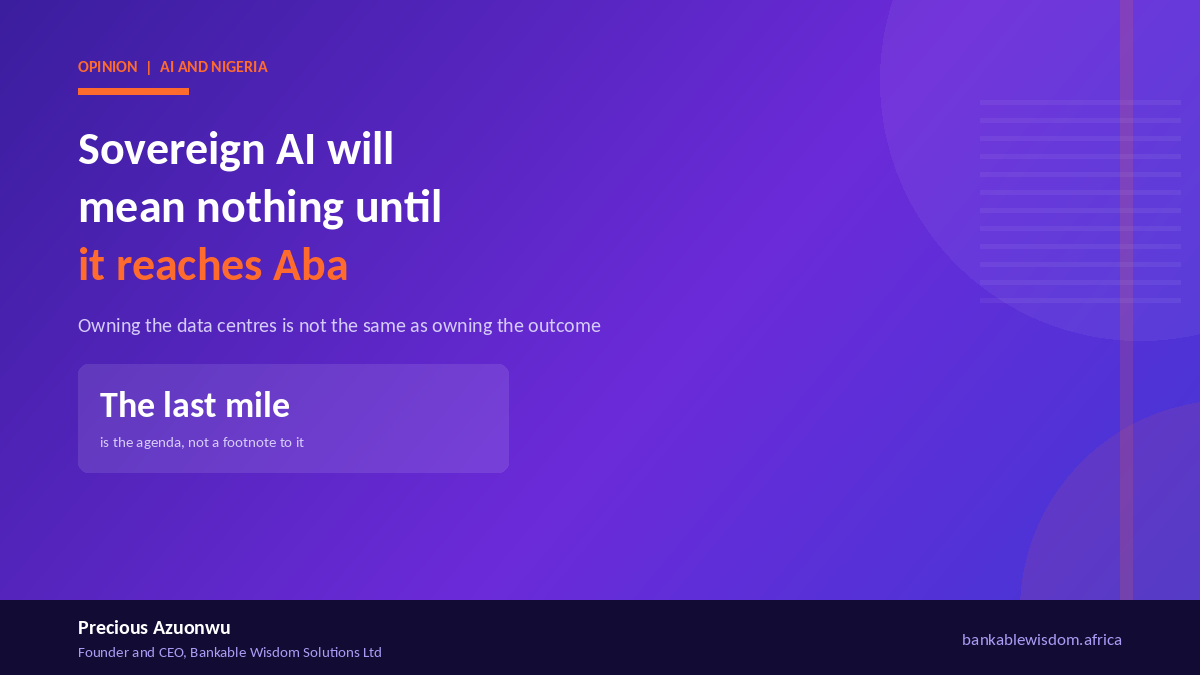
Sovereign AI will mean nothing until it reaches Abia
Nigeria has decided what it wants to be. At GITEX Nigeria 2026, NITDA's Director General Kashifu Inuwa Abdullahi argued that AI should no longer be treated as just another technological tool, and that for Nigeria, control over it has become a matter of economic resilience, national security and digital independence, covering the full chain from connectivity and computing capacity to data centres, cloud infrastructure, data governance and AI models. The event ran under the theme "Beyond Connectivity: The Bridge to Sovereign AI and Innovation", and the government's framing was that Nigeria wants to move from being a consumer of technology to a producer and exporter of digital solutions.
I agree with all of it. My worry is not the ambition. My worry is where the ambition stops.
Sovereignty, as it is currently being described, is an infrastructure conversation. Compute. Data centres. Cloud. Policy. Those things are real and expensive and someone has to build them, and I am glad the state has put its name on the problem. The stated objective is to keep more data and technological capability inside Nigeria, and that could determine whether we end up a market for foreign technology or a producer within the global ecosystem. Fair. But a nation can own every rack in every data centre in Lagos and still have a population that uses none of it. TechCrier
Here is the test I would apply. A woman selling building materials in Aba. A graduate in Yola with a good phone and bad bandwidth. A clinic in Owerri drowning in paper. On the day Nigeria achieves sovereign AI, what changes for those three? If the honest answer is nothing, then what we have built is not sovereignty. It is landlordship. We will own the infrastructure and rent it back to ourselves while the tools people actually use are still designed elsewhere, for someone else, in English they do not speak at home.
The last mile is not a footnote to the sovereignty agenda. It is the agenda. As one analysis of NITDA's position put it, AI systems are only as trustworthy as the infrastructure and data arrangements behind them, and if local developers cannot access affordable compute, Nigeria will mostly consume AI built around other people's priorities. I would push that further. Even with affordable compute, if our builders are solving problems they read about rather than problems they have lived, we will produce a generation of Nigerian-hosted software that still does not fit Nigerian life.
Three things would tell me sovereignty is reaching the ground.
First, delivery through the channels people already use. We have five years of data on this at Bankable Wisdom, and the lesson is not complicated. People do not download a new app for training. They open WhatsApp. Our cohorts run there because that is where the users already are, and 7,147 certified learners later I am confident that meeting people on the channel they trust beats building something beautiful they never open.
Second, measure adoption, not attendance. The talent programmes named at GITEX matter, and initiatives like DL4ALL, 3MTT and Project BRIDGE are part of the effort to expand Nigeria's technical talent pool. But the number that should be reported is not how many people enrolled. It is how many are using AI in a business or a job six months later. Enrolment is a press release. Adoption is an economy.
Third, build for the constraint rather than apologising for it. Low bandwidth, shared devices, intermittent power and multiple languages are not obstacles to Nigerian AI. They are the specification. Anyone who builds well inside those limits has built something that works in most of Africa, most of South Asia and half of Latin America. That is an export product, which is exactly what the sovereignty agenda says it wants.
The private sector does not get to sit this one out either. Government can set direction, but infrastructure requires capital, execution and maintenance, and banks, telcos, cloud providers, startups, universities and investors all have to help build the stack. Those of us who train, who build, who run cohorts, have a narrower job: make sure that when the compute arrives, there is a population ready to put it to work.
Sovereignty measured in data centres is a start. Sovereignty measured in what a trader in Aba can do on a Tuesday morning is the finish.