Latest News on Our Blog
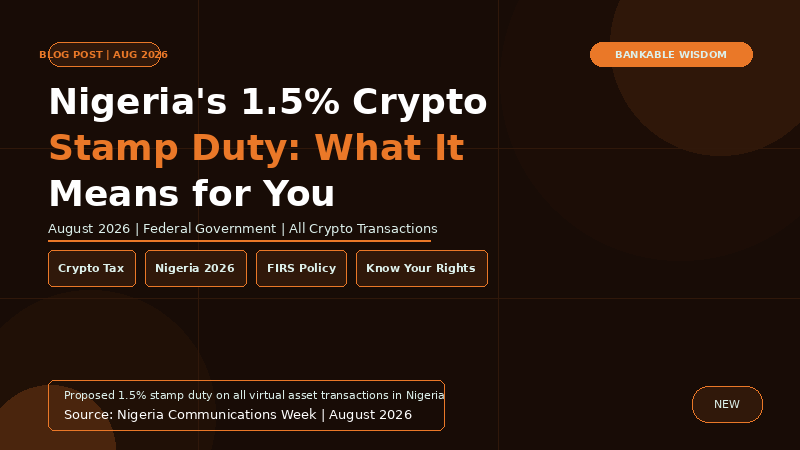
Nigeria's 1.5% Crypto Stamp Duty
There is a new number circulating in Nigeria's tech and crypto community in August 2026, and it is generating exactly the kind of heated debate that tends to follow whenever government and digital assets occupy the same sentence. The number is 1.5. As in 1.5 percent. As in a proposed stamp duty on every single virtual asset transaction processed in Nigeria.
The conversation around Nigeria's proposed 1.5% stamp duty on virtual asset transactions has quickly become a debate about the number itself — is 1.5% too much, will it make crypto more expensive, and will users simply move elsewhere? These are not abstract questions. For the millions of Nigerians who use crypto to receive international payments, protect savings against naira depreciation, or trade as a primary source of income, this proposal lands directly on their financial lives.
What Is the Proposed Stamp Duty?
A stamp duty is a government levy applied to financial transactions — historically used on physical documents like contracts and property transfers, but increasingly being extended to digital financial activity. The proposed 1.5% levy would apply to virtual asset transactions, meaning every time you buy, sell, send, or swap crypto through a registered Nigerian platform, 1.5% of the transaction value would be collected by the government.
To put that in concrete terms: a ₦500,000 crypto transaction would attract a ₦7,500 duty. A ₦5 million transaction would cost ₦75,000 in duty alone — before any platform fees or spreads. For high-frequency traders and businesses using crypto for cross-border settlements, those numbers compound quickly.
Why the Government Is Proposing This
The Federal Government's position is not unreasonable on its face. Nigeria's digital economy is transitioning into a mature phase where profitability and infrastructure investment take more central positions — and where the government needs sustainable revenue streams to fund digital economy initiatives. Taxing virtual assets is part of a broader global trend. The US, UK, Kenya, and South Africa all have some form of crypto taxation framework. Nigeria formalising its position is, in principle, a sign of regulatory maturity rather than hostility.
The concern is not whether to tax crypto. The concern is whether 1.5% — applied at the transaction level rather than on profit — is a rate that reflects the realities of how Nigerian crypto users actually operate. Most retail crypto users in Nigeria are not wealthy traders. They are young professionals hedging against inflation, freelancers receiving dollar payments, and small business owners managing cross-border payments in an environment where the banking system still has significant gaps.
What This Means for Nigerian Crypto Users Right Now
First: this is a proposal, not yet a signed policy. Watch for official FIRS announcements and follow updates through Nigeria Communications Week and TechCabal for confirmed implementation timelines.
Second: if you use crypto regularly — as a trader, a freelancer receiving international payments, or a business owner settling invoices — now is the time to document your transaction history clearly. Clean records will matter when compliance obligations are formalised.
Third: the Central Bank of Nigeria has opened a testing track for permission-based data sharing, with applications closing 31 August — a sign that financial data infrastructure in Nigeria is evolving rapidly. The crypto stamp duty sits within a broader regulatory tightening that is reshaping what it means to operate in Nigeria's digital financial space.
The Bigger Picture
Nigeria has over 13 million crypto users — one of the largest populations of crypto holders on the continent. How this policy is designed and implemented will determine whether Nigeria becomes a model for responsible virtual asset regulation in Africa, or whether it pushes activity underground and offshore. The debate happening right now in Nigeria's tech community is not just about 1.5%. It is about what kind of digital economy Nigeria wants to build.
Stay informed. Stay compliant. And if you build products in the fintech or crypto space, make sure your legal and compliance frameworks are being reviewed in light of what is coming.
Bankable Wisdom Tip: If you are a Nigerian techie working in fintech, crypto, or digital payments, understanding tax and regulatory frameworks is no longer optional — it is part of your professional value. Add a free course on financial compliance or digital asset regulation to your learning list this month. The professionals who understand both the technology and the regulatory environment it operates in will always be the most hirable ones in the room.
Follow updates: https://www.nigeriacommunicationsweek.com.ng