Over 20+ New Jobs Daily
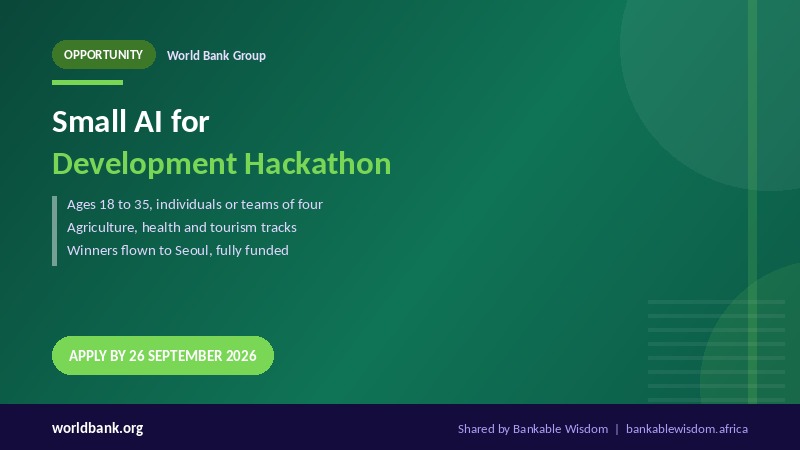
Opportunity Title: World Bank Group Small AI for Development Hackathon 2026
The World Bank Group has opened applications for its Small AI for Development Hackathon Challenge 2026. It is organised by the World Bank Group's Digital and AI Vice Presidency, working with the Youth Summit, the Development Economics Vice Presidency and Information and Technology Solutions, with Hack-Nation managing the platform, and it invites young innovators to spend one weekend building a working small AI solution to a real development challenge in a two-day competition on 3 and 4 October 2026.
The framing is the interesting part. Most AI tools have been built for a world with reliable connectivity, a smartphone in hand and a user already fluent in how to interact with AI, and this challenge asks young innovators to build AI solutions that work in the real conditions facing developing economies, where the people with the most to gain are furthest from the tools being built. The World Bank describes Small AI as a targeted approach that focuses on solving a specific, well-defined problem rather than building a large general-purpose model.
That is a Nigerian brief if ever there was one. Patchy data, shared devices, users who have never typed a prompt.
The tracks
Three sectors are open: agriculture, health and tourism. Three winning entries are selected, one from each sector, and each winning individual or team receives an all-expenses-covered trip to Seoul, South Korea to showcase the solution at the Global AI and Digital Summit 2026. The summit runs from 19 to 22 October 2026 and is co-hosted by the World Bank Group and the Government of Korea, with travel expenses covered in full subject to reasonable travel costs, accommodation and designated event-related expenses. For a winning team, only one representative travels to Seoul, and the World Bank judging panel decides who that is.
Who can apply
Applicants must be aged 18 to 35, in line with the UN definition of youth, and across World Bank member countries, with applicants from emerging economies strongly encouraged. You may apply individually or as a team of up to four members, every team member must register individually and meet the eligibility requirements before the registration deadline, and an individual may only take part in one competition entry. World Bank Group staff, consultants and interns are not eligible.
The two-step trap
Read this part twice, because people lose entries here. Eligible applicants must complete the Hack-Nation application process by 26 September 2026, and those registered and accepted then develop their Small AI solution during the official hackathon on 3 and 4 October, submitting the completed entry through the designated Hack-Nation platform during the competition window. Registration alone does not constitute a competition entry. Both stages must be completed to be considered for judging. The application form currently requires you to sign in with Google, so have an active Google account ready before you start, and everything must be submitted in English.
Official page: https://www.worldbank.org/en/events/2026/10/19/global-ai-and-digital-summit-2026
Bankable Wisdom tips
- Small means small. The word "small" is not a modesty setting, it is the judging criterion. One narrow problem solved properly beats a platform that does six things badly. A model that helps a Kano agro-dealer identify one crop disease from a photo will score higher than "an AI ecosystem for African agriculture".
- Design for the constraint, then say so out loud. Judges are explicitly looking for solutions that work in low-connectivity, low-device conditions. If your solution runs on WhatsApp, works offline, runs on a 3G connection or handles Pidgin and local languages, make that the first line of your submission, not a footnote.
- Apply today, not on the 26th. Applications are processed in batches, and submitting in the earliest remaining batch is stronger than crowding the final day.
- Form your team before you register. Every member registers separately and must be linked to the team before the deadline closes. Sorting this out on the 26th is how teams get split.
- Prepare your assets before 3 October. You have one weekend to build. Go in with your dataset identified, your stack chosen and roles assigned. Spend the weekend building, not deciding.
- Pick your sector by lived knowledge, not by prize odds. If you have worked in a clinic, go health. If your family farms, go agriculture. Judges can tell the difference between someone who has seen the problem and someone who read about it.
- Record a clean video. The process includes a video submission. Good light, clear audio, show the thing working. Do not spend three of your four minutes on the problem statement.